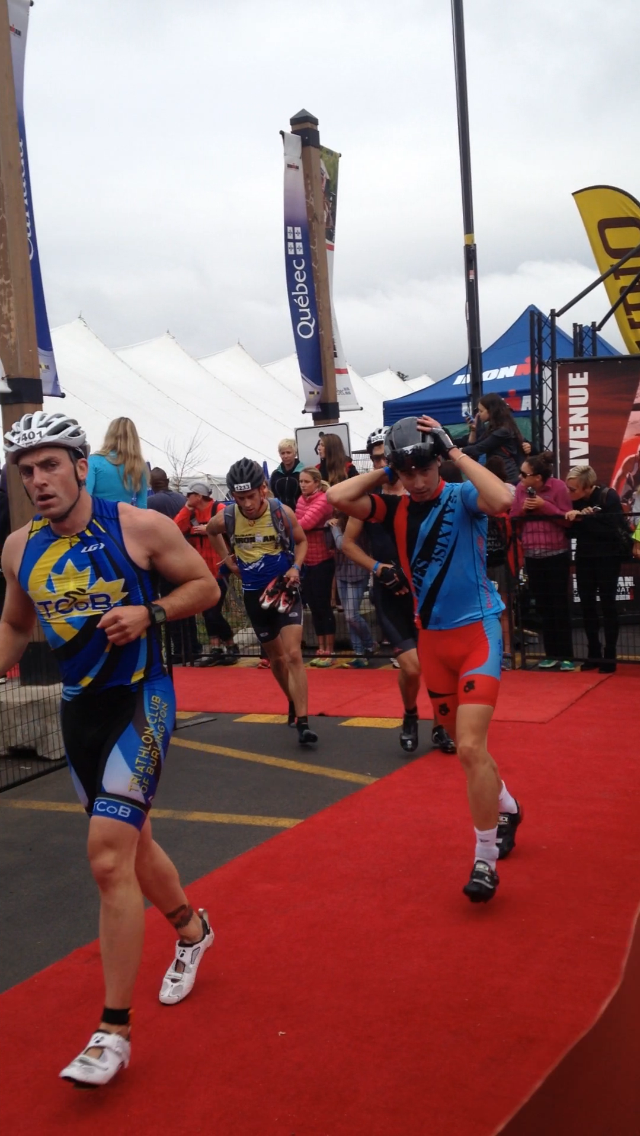
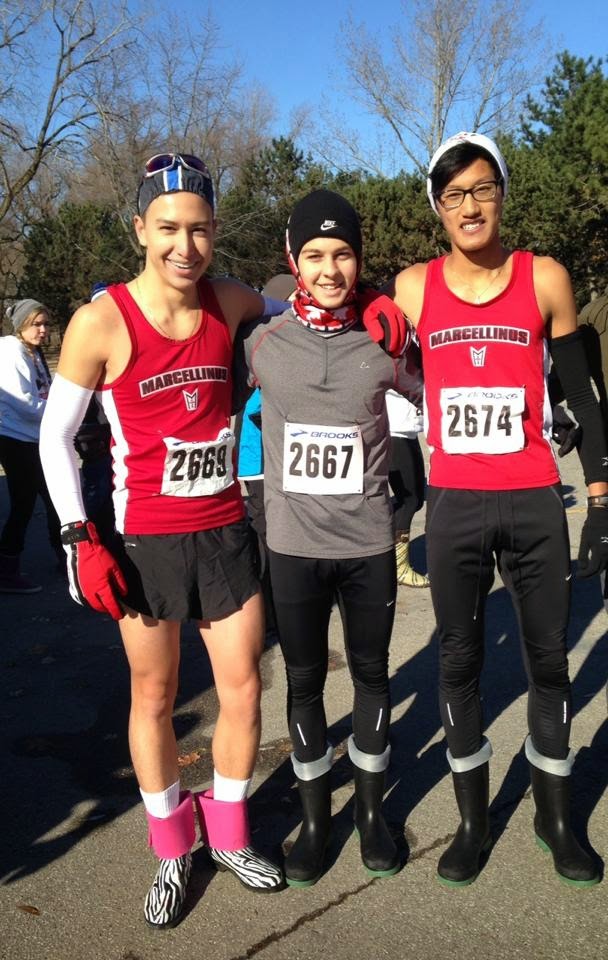
June 21st ended up defying the
weather reports and turned out to be a beautiful day. The predicted
thunderstorms turned into a calm, cool summer solstice. To the disappointment
of the team, June 21st was the date of 2 major races that we were
planning to all tackle. The outcome was the team splitting into two squads for
the day: one competing at the 76km Tour de Waterloo and the other competing in
the Toronto Triathlon Festival Olympic Distance. With conditions of both events
the exact opposite from last year, it was a successful day all around.
Tour de Waterloo (Ed, Parichit, Garima,
Adam, Marcel)
This event last year made for an exciting day. Amongst the team, we experienced nearly every scenario imaginable from
success, to mechanicals, to crashing, to bonking, to completely missing a turn
and riding off course.
At 45km in to this 76km race, Adam and
Marcel were dropped from the main group. They ended up in a chase group and
finished side by side in 57th and 58th place overall,
good enough for 4th and 5th in the 20-29 age group.
Ed and Parichit were able to hold onto the
peloton but a late solo attacker broke away for a solo victory by over a
minute. In the bunch sprint for secondary positions, Ed finished 21st
overall and Parichit came in 4 spots back at 25th. They were able to
secure 1st and 2nd in the 20-29 age group, respectively.
Garima competed in the 46km race and held
on for an amazing third place finish, barely missing out on second in the
sprint final.
It was a hugely successful day for the team
given that we were able to saturate the men’s 20-29 age group and achieve an
overall podium!
Well deserved meal!
Toronto Triathlon Festival (Tyler, Lucas)
The 2015 TTF was a race that I had been
targeting for a full year. It is my favourite race to compete in – the fast,
flat course in the downtown core makes for an exciting race. The weather held off to give nearly perfect conditions, a nice contrast to last year. On the table for
this event were qualifying spots for the 2016 ITU World Championships in
Cozumel, Mexico. This was the main target for my race as my attempts at
qualifying in the past were shrouded in bad luck.
I felt pretty good going into this race.
All of my pre-season tests had me optimistic. However, lack of available pool
time at my local community center and a busy week at work seemed to have
weakened my form and allotted me a less than optimal taper. A 50+ hour week doesn't leave much time to relax or even stretch the muscles.
As mentioned, the day turned out to be
perfect, with the water completely calm and there was little wind. The swim
didn’t feel too good though. I knew my swim wasn’t on ideal form and it took me
around 750m to get into my groove. 400m in, Lucas literally swam over me and
took off ahead. So the chase began. On exiting the water I just felt odd
and like nothing was in sync. After an unusually long T-1, I ran up the hill to
the bike mount and struggled to put on my shoes, having to stop at the side of
the road so get everything secure.
The calm before the storm. This is the first time I've ever spotted myself in a mass start swim. Lucas and I are 4th and 5th from the right on the bottom row.
To make matters worse, for some reason my
computer wasn’t picking up any signals from my speed sensor. Once I fixed it on
the go, it kept sporadically cutting in and out. I had planned a target for my
power and soon realized I would have to revert to good old feel. My legs felt
sluggish and all I could do was press on and hope for the best. I kept pedalling
away and 500m from the turn around, I saw Lucas headed back in the opposite
direction. I caught him with 30km to go and we essentially got to T-2 together.
As in the swim, it took me a while to find
my legs. It just didn’t seem to be my day. I was running on track to my goal
time of a sub 40-minute run until my T.A. tendinitis began to flare up at the
5km mark. My pace dropped dramatically as I stumbled to the finish. My leg felt like it had gone up in flames.
All in all I came in at 2:14.48, which was
a new PB for myself. I averaged 1:45min/100 in the swim, 37.7kph on the bike
and 4:10min/km on the run. It was good enough for 32nd overall, 2nd
in my age group and a ticket to the 2016 ITU World Championships in Cozumel,
Mexico. After some review, an elite athlete won my age group, winning the
entire race in fact, and I was a little confused as to why he would be in the
AG division. My best guess is that since it was a WC qualifying race it was a
way for him to qualify? If anyone has any suggestions please let me know, I’m
not too familiar with the pro-athlete system.
Lucas finished just 2 minutes behind
myself, with a 2:16.59 finish in his Olympic distance debut.
Typically, I am a few races into the season
by TTF so all of the kinks are worked out. With this race being pushed up to
accommodate the Pan-Am Games, I don’t think I was quite prepared both mentally
or physically. I wasn’t able to train due to work and I made some dumb mistakes
with my race set up - things that by this point should have come second nature. It was 10 months since my last race so it wasn’t as smooth
as I would have hoped. The main target of my race was to qualify for the World
Championships so in that sense my day was a success. Qualification wasn’t graceful
but I qualified and that was the main thing.
Podium Shots
One thing I should note is that I had a 9
minute buffer to the 3rd and final qualifying spot. For years of
tough competition, I was always caught out of a spot due to the high level of
performance. It seems odd that on a day where I felt my worst, I was able to
get in.
I am disappointed with my performance despite the huge PB. Cody Beals put it best in his 70.3 IMMT recap when he described his race referencing @Jackmott: "I was too slow and I was too dumb, but I'm not too dumb to learn from my mistakes!" I know I can do better and am hungry for improvement and that is a factor that will drive me to better myself come next September. In my 7+ years of racing I have never had a 'bad' race. The fact that I'm calling a PB race 'bad' may prove that I have a screw loose in my head, but now I'm just rambling.
My goal for Cozumel is what I'm calling 40 up/40 down. I want to get through the swim in 20 minutes (not factored into the name), average over 40 on the bike (40 up) and run a sub-40 run (40 down). These are all goals that I believe I can strive to achieve, marks that I had planned to hit on Sunday. As always, a huge thanks to our sponsors 3Sixty5 Cycling, DuTriAndRun, and Eagle Partners for their continued support!
Next up for the team is the Tour de Terra Cotta on August 3rd.
Pre-Season Thoughts This winter was the first time that I
really had a solid winter training program to carry over my fitness from the
previous summer. In past years I would either just swim on my high school swim
team (no running or cycling) or just attend a few spin classes with the
University of Waterloo Cycling Club. The reason for this was because I felt
that after hard summers of racing and training, I needed to let my body rest
and recuperate. This led me to play a lot of catch up with my fitness in the
early spring in preparation for triathlon season. As I have developed as an
athlete, I feel stronger and am more in-tune with my body. I have a better
understanding of my limits and can recognize the preliminary triggers that
indicate when to back off to prevent injury.
My training over the winter consisted of
running indoor track with the University of Waterloo as well as temporarily
filling in as spin class instructor for the University of Waterloo
Triathlon/Cycling Clubs. Due to scheduling conflicts, I was not able to make it
into the pool as often as I would have liked but probably averaged one or two
swims a week. This resulted in 2 intense track workouts, 2 spin workouts and
the odd swim per week.This was all I
could really handle with my schoolwork but it has seemed to have paid off in my
pre-season tests.
The last few racing seasons have started
off hopping straight into either an Olympic or Half-Iron triathlon after a 7
month break from racing after XC. My performance was always a crapshoot but
more often than not I was satisfied and it allowed me to make modifications to
my training program. The problem with this is I feel there are only so many 'zones' you can target off of one race, especially one as long as a Half-Iron, as
performance factors may start to amplify and you lose a degree of certainty on
the factor you are assessing. For example if you feel bad on the run it may not
be because of your running form, it could be a whole wack of factors beginning
with the swim or nutrition on the bike. One may take that as a cue to kick up
the running training when in actuality swimming or nutrition may be the area of
interest.
In retrospect, I had not planned for any
pre-season racing this year. My family decided to compete in the Mississauga 5k
so I figured that I would join in and I registered for the Grey County Time
Trial one day before registration cut-off in a spur of the moment decision.
Reflecting on the past few weeks, I am happy with my decision to race and plan
on making it a yearly routine.
I cannot recall the last time I competed in
a running road race. My take on the shorter races was if I wanted to run 5k or 10k, I would
just go out running on any given day. That would give me a pretty good
indication of my times right?
Mississauga Marathon 5k
The Mississauga 5k took place the day after
our #TTFU OYL Cycling Collingwood Training Camp. I felt pretty fatigued, and
hadn’t run in nearly 2 weeks. I hadn’t run a speed workout in over a month. My
plan going into the race was to at least break 20 minutes and, being optimistic,
hope to crack the top 10. At the start line, I was in the middle of the mass
corral. At 5 minutes to start, the announcer requested that all “elite” runners
enter the box at the line. He described the elite runners as “they know who
they are”. Four runners moved up and my dad gave me a shove. I had my
reservations about moving up because I doubted my form. Slowly after I arrived,
about a dozen boys about a foot shorter than me joined us. I was nervous in the box but it was a risk that paid off.
I’m sure it was due to the pressure of the
elites, but as soon as the gun went off I found myself sticking to the front. A
few guys sprinted the first kilometer but soon died off. After everyone settled
in, I found myself move from around 15th to 6th overall
from kilometer 1 to 4.5. I was sort of in no mans land as I was ahead of the
main bunch, but far behind the leaders who would end up besting me by 2
minutes. It was a very flat course with hardly a bump in the road. In the last
500 meters, to my surprise, I found one more gear to pass the 2 running just in
front of me. I finished in 17:39, finishing my last kilometer in 3:12. That was
good enough for 4th overall and 3rd in my age group. As primarily a triathlete, this race changed my views on running road races. There is no way I could have run a sub-18 5k on my own. It was a good training session and a great way to assess my fitness in a race scenario. I plan to incorporate more running races into my training schedule in the future.
Happy at the finish line
Grey County TT (29.1km)
My second pre-season test was the Grey
County Time Trial. It was a totally last minute decision to sign up and by the
time I made the call, it was too late to return to my flat in Waterloo to grab
my 3Sixty5 Legacy wheels or any warm clothes (which I would end up paying for
later). All of my warmer clothes are in Waterloo because that was where I was when I was training in the winter. My set up was less than ideal but given the circumstances I made do with what I had on hand.
As shown on the map, it is an out and back course starting on top of a hill with a pancake flat middle section followed by the return climb. One reason I was excited about this course was it ran right along where we rode many times during our #TTFU training camp. I knew the road fairly well.
One of my biggest challenges and worries
leading up to the race was the legality of my bike. Since it was a UWCT
qualifying race for the World Amateur Championships in Denmark, in order to be
in contention, you must have had a UCI legal set up. After much research and
measuring, I finally figured out the most optimal set up with the gear that I
had. I ended up switching from my Pinarello to my Trek and completely changing
my aero bar extensions and riding position. I even had to make some last minute
adjustments 5 minutes before my start time to comply.
A little perspective for you triathletes - I'm not sure if it was just my set up, but the right was my normal bar length and the left is the UCI maximum length for TT bikes. This drastically changed the geometry of my set up and forced me to adapt a different riding position. I may keep it for a while to see how it feels - I have long forearms so I keep kicking my elbows, however.
The weather had been solid all week, and
the rest of the weekend was looking beautiful. Unfortunately, the Friday of the
race was an outlier with a high of 8 degrees and 25km/h winds. My start time
was 17h51 so just before dusk on the start line it was 4 degrees. With the wind
and at speed it felt like 0. Trying to keep aerodynamics in mind and my lack of
preparation, I only had arm warmers, shorts, and a jersey.
The starting ramp was awesome, felt like I was in the Giro!
As soon as I pushed off the starting ramp
(which I was stoked about having), I knew something was wrong. For some reason
I was seeing double and felt incredible light headed. I felt drunk and
everything looked like a cheap movie effect. I thought the wind was making my
eyes water but it was the cold. Pushing so hard in such cold conditions really
took its toll on me. Right from the gun I was in a battle to keep on a straight
path, avoid road obstacles and not fall over. It was surreal and like nothing I
had ever prepared for. In the last 100m push my vision completely disappeared.
Luckily I managed to roll to a stop before lowering myself to the floor.
My jersey all pinned up
This race had fabric numbers - not paper, which was a first for me. No more annoying flapping in the wind!
I finished 13th out of 22 starters in the 19-34 AG with a time of 47:01 over the 29.1km. It wasn't a stellar performance relative to the other competitors but it was a decent effort for myself. I didn't end up qualifying for worlds in Denmark, as the top 25% in each age group got a ticket. It will definitely be a target of mine in the future though.
Final kick to the line
Take Aways
I am happy with my current running and
cycling form - I am already far ahead of where I was last year at this time. My
first true test of my swimming will come at my first triathlon of the season. I
feel I have a good base in all 3 disciplines; from here it’s time to do some
race-specific training to tie everything together. After analyzing my data and performances,
I have a few changes to make to my training program to be fully prepared for my "A" races.
So far, my season schedule is as follows:
June 13-14 TBN Niagara Ride
June 21 Toronto Triathlon Festival –
Olympic Distance
August 3 Tour De Terra Cotta
August 8 MSC Bracebridge –
Sprint/International Duathlon
September 5 Somersault Canadian Iron 226
In addition, OYL Cycling is planning on
sending athletes to the following events:
June 14 Cambridge Tour de Grand
June 21 Tour de Waterloo
August 3 Tour de Terra Cotta
Spetember 27 Tour de Hans
I hope to see many of you out there on the
roads and at races! If you plan on attending any of these events shoot us a
message!
Contact:
On Your Left Cycling-
From April 28th to May 1st,
we rode longer, farther and harder than any of us had ever ridden before. To
kick off our sophomore year, we decided to get the ball rolling with a team
training camp to Collingwood. I thought it would be a good idea to get the legs
moving after another long winter and get the new recruits into the groove of
group cycling. Before this week, the farthest some of our riders had ever
ridden was 60km. Boy, were they in for a shock to the system! I am extremely
proud of all of the boys for sticking through and pushing on. We all had our
bonking points (who wouldn’t have a bad kilometer or two in a 20+ hour week?)
and it was great to see the drive and perseverance to continue on. It really
gave me the chance to evaluate the motivations and mindsets of this year’s
squad. None of us had ever really ridden together before this week but I now know
they are some of the toughest roadies out there.The development that I saw in those 4 days
alone has me very optimistic for the rest of the season.
Hillside view from our balcony was awesome, spent some time just watching the slopes
Over the course of 4 days, we rode ~625km
in 21 hours of total rolling time through the beautiful roads of Collingwood.
Having access to one vehicle, the
transportation arrangements were pretty tricky to sort out. This left Ed and
myself to ride up from Waterloo to Collingwood, while Lucas, Alex and Adam
drove. The expedition to Collingwood was a tough one. It was uphill 95% of the
way (as shown in the graphic below) into a killer headwind. To make matters worse, when we embarked on our
journey at 6:30 am, the temperature was teasing the negatives. With the
weatherman calling for a high of 17degrees later in the day, I thought I would
rough it out with shorts and fingerless gloves. This turned out to be a mistake
as the weather stayed frigid for the first 3 hours of our trek. 30 km in, we had
to pull into the Fergus Timmies to warm up. Great start to the camp. Toeing the
line between frostbite and hypothermia, we carried on to meet up with the car
in Shelburne.
After a hearty refuel, Alex joined us and
we continued into the home stretch. When Adam and Lucas got to the hotel, they
unpacked their bikes and rode the reverse route to meet up with us 30km out and
we rode to base camp as a group. On day 1, due to the hectic transportation, we
each rode between 60km and 175km.
Day 2 saw our first real ride together and we broke it into 2 sessions: a morning easy ride and an afternoon hill climb workout.
The morning ride was more to get the legs moving, especially for Ed and myself after a long 7-hour day before. The route was a recon of the Grey County RR some of are planning to compete in.
The later ride was short and not so sweet.
We began with the Scenic Caves HC (from the centurion hill climb), a sprint down Route 2 before climbing the
back of 19 and bombing down it. It was a shorter, fast paced workout type ride, simulating our spin classes that we had run over the winter.
Our big hitter was on day 3, where we
planned a century ride. Somehow that turned into an 180km Iron distance ride; including
lunch and snack breaks, we were out for over 8 hours. Looking back on it now, the elevation shows an absurd amount of climbing!
Someone was out at 120k
The ride back to Waterloo, surprisingly enough seemed
like the easiest. Despite the 15 hours of riding of the last 3 days, we made it
back in 5 hours of rolling time (2 hours quicker than the ride out). Maybe it was that my body had become numb or
the massive tailwind or the downhill profile that helped us. We paced the first
90km at half-Iron pace and the back 80km at Iron pace effort.
Timmies Pit Stop on the Return Trip
All in all I think for our first camp, it
went as well as it could have been. With over 100 hours of combined riding between
the 5 of us, we surprisingly had no flats or serious mechanicals (a few
dropped chains and flying bottles are nothing to complain about). It also seemed we
chose the perfect 4-day gap to hold the camp, as the weather was great with
seemingly no wind so complain of. Aside from the first morning, the weather was
consistently in the high teens and it literally rained for 20 seconds (I timed
it) during our descent into Creemore on the third day.
A little candid shot
A banana and twizzlers - definitely Pro Tour musette material
The posthumously named “#TTFU Training
Camp” was some of the best cycling I have ever done, made even better by great
company. I definitely want to plan another trip for next spring. It was a great way to jump into cycling after the winter and a great break after a tough exam period.
A huge thank you to our sponsors who helped to make this camp possible: Eagle Partners Financial Solutions, 3Sixty5 Cycling and Du Tri and Run. 3Sixty5 delivered a pair of their Lunar 58 wheel sets to Lucas just in time for the camp (picked up enroute), and according to the happy new owner "they're so slick, they make a waterslide feel tacky!"
Some of our fuel for the week provided by Du Tri and Run & Endless Endurance
Looking forward to the season, we plan to send a team to the Grey County RR (May 24), the Tour De Waterloo (June 22), the Tour De Terra Cotta (Aug 3), as well as an assortment of triathlons.
As a side, if anyone has any recommendations for free video editing software, please shoot me a note. The native app that came with the camera is very rudimentary and tough to navigate (which is why this blog took so long to upload). I have around 30GB of footage from the trip that I want to do stuff with. I'll upload a better video when I can make one.
“Exactly
one year ago yesterday I decided to embark on the greatest journey of my life.
Sitting on my hotel bed in the middle of Manhattan at 10 a.m. running on
$20/hour WIFI with credit card in hand, I registered for the 2014 Subaru
Ironman North American Championships in Mont Tremblant. Unbeknownst to me, I
had no idea what I was signing up for.”
All of my race gear
My loyal steed equipped with my trusty 3SIXTY5 Cycling 50/88MM clinchers
Prepping my race day bags, hoping I remembered everything!
Headed off to transition
If you were to fast forward 363 days, 20
hours and 18 minutes from that moment, you would find me standing on the beach
at Lac Tremblant in my wetsuit and swim cap about to soil my speedo (urinate is
more accurate… I actually really had to pee).
The last 6 years of my competitive racing
career has all led up to this very point, from that first swim team try-out
back in grade 9. My goal was simple: finish the race and claim a title so few
people will ever attempt to achieve – one even fewer will succeed in obtaining.
The day before my race, I stepped down out
of bed and a cringe overtook my face. My posterior tibial tendinitis that had
disappeared for months has just struck again out of nowhere. I took extra care
that day to nurse my ankle and hope the pain would be gone by morning. It was
not.
As the pros took off, the white caps were
corralled through the large blue Subaru arch into the starting box. So many
emotions were flooding my head and before I knew it I was standing at the edge
of the water surrounded by 300 other athletes. Some were first-timers and some
were seasoned veterans but no doubt every single one was both excited and
nervous for the coming hours. “Less than
a minute to go”, the MC announced over the speakers. And then it hit me. I
was about to start the most difficult single day sporting event in the world -
the magnitude of which I wouldn’t fully understand nor appreciate until almost
12 hours later. I envisioned all of my training sessions, all of my supporters,
my teammates, my coaches, my training partners, my inspirations, my sponsors
and remembered how prepared for this I was. “10 seconds!” Here we go, no turning back now. You’re going to rock
it.
BOOM.
And just like that the fireworks went off
and the greatest day of my life had begun.
I had been in a mass start of a triathlon
before, but nothing like this. I had planned to take it out excruciatingly slow
but soon found that I couldn’t. Stupid me, lost in my inner thoughts, went and
stood smack dab in the middle of the wave. I had never been in a group so
crowded. For the first 500 meters at least, I was swimming on top of people,
punching heads, kicking faces – it was as if I was swimming in a sea of people
with no water even present. Did I feel bad about my dispensed abuse? Of course
not, because the same treatment was directed back at me 10x as bad by the
athletes around me. My ankle hurt for the first 15 minutes or so but the pain
subsided… for the time being. I imagine it just needed time to warm up. After
the chaos that was the mass start, it was a pretty typical swim other than the
fact that it was 3.8km. The sun was mostly hidden behind the thick clouds so
the sun in your eyes wasn’t as big a problem as I had anticipated. A way that I
combat that is to always breath away from the sun, if possible, which isn’t bad
on an out and back course because you would switch sides at the turnaround.
Since that wasn’t the case I was able to do my usual bilateral breathing and
soon got into my rhythm. I found I was swimming relatively straight with the
help of very conveniently placed buoys. I usually really zigzag along the swim
pretty bad but the buoys were the perfect distance from each other that I
didn’t have any issues. One thing I will note is that I hadn’t thought to
locate the swim exit beforehand, so as I was nearing the finish I realized I
had no idea where I was going. Every few minutes I would look up to try and
find it through my foggy goggles. Luckily with about 200 meters to go I
realized it wasn’t straight ahead near a white structure as I thought but
actually more to the left under a blue arch. I was far enough out that it
didn’t affect my trajectory too much and I made a B-line for the beach.
The top half of my suit was off by the time
I exited the water to find the race clock reading 1:15. Calculate in the 6
minute staggered start and I was clear in 1 hour and 9 minutes. That was within
my range of predicted finishing time and in fact 1 second off of my best half
ironman pace, so it was a stellar swim for me. I strolled over to the *wetsuit*
strippers who yanked the neoprene off and made my way to T1. I had never used
the strippers before at a race but it was definitely way more efficient. With
my arms like jello after the swim, I’m not sure I would have even been able to
pull the suit off of my legs by myself. It was a quick 300m jog to the big
white transition tent to grab my Swim-Bike bag, but before I made it there I
found a conveniently placed port-o-potty to relieve myself after an hour and
nine minutes of holding it in.
Swim run up
For those of you who have never done an
Ironman branded event, transition is much different from a usual triathlon.
Normally, you are given a spot at the bike rack where you can set up your bike
as well as lay out your equipment on the floor for the rest of the race such as
running shoes, hat, helmet, etc. When you change from discipline to discipline,
you just run to your spot and “transition” to the next sport. I knew prior to
my arrival that transition was done a little bit differently at an Ironman, but
the process was completely foreign to me. It was much easier and faster and I
can see why they only do it at Ironman races. When you run into the big white
tent, there are aisles of transition bags lined up in numerical order according
to your bib number. You run down the aisle containing your number, grab your
bag and proceed to the changing room in the middle of the tent. Myself, being
so inexperienced, grabbed my bag and started my transition while I was stood in
the middle of the aisle! Luckily I didn’t get very far before a volunteer
guided me to the changing area. I knew what I was supposed to do, but in the
heat of the moment I was so disoriented and in the zone that I was just doing
what I thought I had to do.
I got to the changing area and got ready
for the bike. The great thing about this transition process is if you planned
everything correctly, you will have everything you need for the bike in your
bag and not forget anything. In traditional triathlons, your cycle and run gear
is all laid out in one pile at transition. It is very easy to forget to grab an
item, which could be detrimental to your race. With the bag process, you know
whatever is in your bag you need to take with you so during the race where you
are dazed and confused, it is tough to mess it up. When done with your bag, you
leave it on the floor and a volunteer retrieves it and places it in an area for
you to pick up after the race. It is fast and very athlete-oriented.
Run to the Bikes!
A quick run out of the opposite side of the
tent brings you right to the bike storage. This is again different from a
traditional triathlon because where there are normally 5-6 bikes on any given
rack (spaced out due to the space on the floor needed by the race gear), since
there is no equipment, there were about 20 bikes crammed onto each rack. My
bike was placed as well as I could have hoped. We were assigned a spot on the
rack based on our bib number, and mine was on an end aisle right beside the
fence, on the side of transition closest to the bike exit. This was ideal since
it involved very little running with my bike to the mount line.
Insane! This is what 15 million dollars worth of bikes looks like!
Past the mount line, I was on and off. I
quickly settled into my pace and felt no stiffness or soreness in my legs from
the swim. It felt as if getting on my bike was the first thing I had done that
morning and had not just swam nearly 4km. Going into the day I knew my cycling
numbers. I knew my maximum power output at any given point should not peak
above 300 watts and I would try as hard as I could not to let it drop below 150
watts. Taking into account the hills and the wind for the day, in order to
maintain my goal average speed, I deviated from this a little bit for the
greater good of my race.
Over the course of the 180km bike ride, my
computer picked up just over 1500 meters of climbing – far less than the
claimed 1800 meters from the official athlete guide. The conditions for the
course were not perfect, but they were manageable. On the way out in the
longest out and back section along the highway, I didn’t realize it on the way
out but it was basically a constant, gradual uphill with a mild head wind. The
temperature was pretty cool and I was wishing I had brought my arm warmers or a
jacket. Despite this, by the ~32km turnaround point, I had averaged just over
31km/h. A nice easy start. As I turned around to head home, I soon realized
just how significant that gradual uphill was. Returning to the village, on the
downhill with a tail wind, I stayed well below my peak power and maxed out my
54-11 gear ratio hitting speeds in excess of 70km/h at some points. My
improvised plan was for the second lap was to push harder on the way out, and
take advantage of the conditions by recovering on the way back.
After a quick detour into St-Jovite, we
were back on Montee Ryan and back in the village by the 70km point. This is
unfortunately where the toughest part of the course lies. Passing transition,
you head out on a 10km out and back section that is essentially a 10km climb
peaking at 15%. To make matters worse for myself, I ran into another competitor
who I noticed was in my age group on this climb. I got too caught up in an
internal competition and may have burned one too many matches trying to counter
his moves and lost him on the return decent. I took the first 15km of the 2nd
loop to recover a little bit from my foolish move, but found by the time I got
back on the highway (with the uphill/head wind) the conditions had gotten worse
and it was tougher to maintain a good average speed while staying in my power
zones. This was my first bonk. Psychologically, seeing my pace drop was a punch
in the gut. I had to keep telling myself that everyone was experiencing the
same conditions and I had to keep on truckin’. I knew staying below peak power
was more important in the long run than keeping up an average pace, so I took
this section easy instead and worked on fuelling up. I needed to save something
for the marathon. By the turn around, I felt a little better and was good to
go.I got my second wind. The only
difficult part about the way back was a pretty large hill about half way back
to Montee Ryan. The closest thing I can compare it too is a much longer,
slightly less steep 6th line hill - for those of you who know that
climb in Milton. I consider myself a pretty good climber and received a little
bit of a confidence boost when I found myself passing nearly 20 riders up that
climb whom I stayed away from for the duration of the ride.
Back when I first started riding, I was on
a 20-year-old steel frame with suicide shifters on the down tube. When I would
ride with my friends on bikes with STI shifters, when we got to a hill, they
quickly shifted to a climbing gear. They would take off up the hill and myself,
finding it too difficult to properly shift gears on the old rusty bike, would
pick a comfortable gear and ride in that gear for the whole ride like a fixie.
Eventually, my legs got strong enough to keep up with them on the hills on a
single gear when everyone else could shift to an easier gear. When I finally
got a proper road bike, with a variety of gears to choose from, I found that
the extra work I did in my early days of riding shaped me into the rider I am
today. I can keep a good cadence on a relatively heavy gear going up hills
while using very little effort.
It was a pretty routine ride for the
duration of the 180km. I started to feel a tweak in my ankle with about 50km to
go. It wasn’t too bad, but enough to make me worry about the run. I kept
fuelling according to my pre-planned schedule of 1 gel, 1 homemade carb square and
1 bottle of eLoad mix every hour. I took the last 20km out and back loop very
easy in order to give my legs a little recovery time before the run. I noticed
it was not just me taking it slower either, it seemed everyone around me pulled
off the gas a little bit and I think that is where the bulk of my average pace
dropped off for that lap.
I rode back towards transition into a sea
of spectators, and pass the dismount line, saw that I was approaching a
blockade of red shirt volunteers at full running speed. Confused, I ran over to
a volunteer who was calling me over. I looked over to some other riders and saw
that they were giving their bike over to the volunteers to carry away. I
thought they only did that for the professional triathletes, but another great
feature of the Ironman event is there are awesome volunteers to return your
bike to the bike rack for you. The event is organized so that the athletes
literally only have to swim, bike and run, nothing else. It takes a little bit
of stress and worry out of the otherwise hectic day.
From there, you jog back into the big white
tent, through the opposite side you had previously, to your bike-run bag.
Again, in a similar process as before, you change in the changing room, a
volunteer takes your bag and you’re off on the run.
Run out of T2
I found the run course to be fantastic.
There were aid stations approximately every 2km and aside from the first and
last very hilly 4 km on the out and back course, it was very flat. My ankle was
not as bad as I had anticipated. It hurt a little, enough to notice, but dull
enough I could easily ignore it. The crowd support was unreal with at least
some sort of supporters nearly every 500 meters. Right from kilometer 0, I
found a fellow athlete running at a good pace for me (around 5:15/km), and
surprisingly kept up with him until the 0km mark running at the same pace. I
didn’t drop back but dropped him! I felt unusually good which just turned out
to be the calm before the storm.
Just finishing my first run lap, passing within 50 meters of the finish line!!! Still feeling good at this point
Usually in my first crack at a longer
distance, I end up walking very early in the run. For example, in my first and
second 70.3 races, I walked at 6km and 9km, respectively. Even in my first
Olympic distance I walked at 4km. Perhaps it was just good power management on
the bike (an privilege I hadn’t had in previous years) or simply just a display
of my hard training but I had planned to take a break every 12km in the run and
didn’t need one until 22km in. I finished the first half marathon in 1 hour and
53 minutes. Well within my goal and almost on par with my best 70.3 split.
Just as I was exiting the village for my
second lap, however even though I physically and mentally felt very strong,
something was wrong – very wrong. I won’t go into details here, but I ran into
a bit of a medical emergency that I had never encountered before nor had I
anticipated at all. All I will say is that the pain was excruciating and I
could barely run for 30 seconds at one point before keeling over. This was my
decision point. I could have dropped out. I could have thrown away 6 years of
training. I actually considered it. The thing that upset me the most was it
wasn’t even as if I bonked or did something to injure myself – it wasn’t even
cramps. I didn’t go out too hard and was right where I had planned to be. By
this point I was 9 and a half hours deep in this commitment, what’s another few
hours of pain right? I’m never one to give up and I was definitely going to
follow this through. After I considered all of my options, there was no way I
was going to quit. I soon began crunching numbers and calculating possible
finishing times even if I did walk the next 20km. I didn’t like it but a 14
hour finish is better than a DNF. For the next 6 or 7 km, I hobbled, struggled
and suffered through the pain. My race pace splits went from ~5min/km right
down to 11min/km at one point. My pace suffered for about 12km. But I kept
going. It was the longest, hardest 12km of my life.
At the furthest turnaround along the path
at Montee Ryan, the pain began to subside. Whether it was the adrenaline of
knowing the race was almost over or simply that I let it heal for a bit, I was
back and the extra time I has rested my legs made me feel that much better. From
the 34km mark I was running back up to my target pace (~6min/km by that point)
and ran steady until the final kilometer which I *sprinted* out in just over 5
minutes, hitting a pace of 3:30/km at one point.
The run turn around point at Montee Ryan
In that final push from 34km, I ate
everything they had to offer – completely disregarding my previous GI issues
and found, despite my bingeing, had no issues whatsoever. I ate pretzels (a lot
of pretzels), chicken broth, coke and even a few shots of Red Bull at the last
aid station ;). My hypothesis is since I had been going for so long, my
digestive system shut down into a primitive state working very slowly;
something I do not have the benefit of when experimenting with foods on a short
run potentially.
Kick down the finishing chute, 20 meters to go!
The finish line was bittersweet. It justified all of the sacrifices I had made. Running
down the finishing chute that snaked through the village I got choked up a
little bit. Running up that famous ramp and under the finishing arch hearing
the voice of Mike Reilly announce, “Tyler Chuang, from Mississauga, You Are An
Ironman!” near brought me to tears. This was a long time coming. All of the
emotions of the day overtook me. Everything I had worked so hard to achieve all
fell into place, albeit with its hardships. The first thing I did after exiting
the finish corral was grab an ice cold Sleeman from the drink tub and
downed it on the spot.
My two most prized possessions at the moment: my medal and beer
5 years ago I had never even heard of the
Ironman. I can remember the exact place and day my best friend told me about
it. It was during a cross-country practice standing outside of the fence to the
track. We had recently just completed our first triathlons and we were keen on
continuing to one-up each other. We were discussing our future plans for the
sport when he mentioned the Ironman. A 3.8km swim, 180km bike ride followed by
a 42.2km run. I thought that was absolutely crazy and that I would never even
attempt that in a million years. An Olympic distance triathlon seemed like a
stretch for me at the time. It seemed huge then and at the time I didn’t even
comprehend just how far that would be. As my career progressed and I got better
and better, the possibility of an IM seemed more and more realistic. I am still
in awe at how far I have come in the last 5-6 years. 5 years ago I couldn’t run
3km. It makes me wonder, if I am lucky enough to be able to continue in the
sport, how far I can take myself. Only time will tell I suppose.
All in all, I finished the day in 11 hours
54 minutes and 9 seconds. I had set time goals for myself beforehand. I told
myself I would definitely have to finish in under 12:30. I would be happy by
breaking 12 hours and a perfect race would be sub-11. I broke 12 hours and I am
happy with my result.
My minimum goal for the swim was a
sub-2:00/100m or 1:20. I completed it in 1:47/100m or 1:09.
My minimum goal for the bike was at least a
30km/h average or 6:00. I completed it with a 30.8km/h average or 5:57. I feel
that I could have gone faster on the bike, but considering my inexperience and
harsh weather conditions, I rode as well as I could have.
My minimum goal for the run was simply just
4 hours. I finished the marathon in a time of 4 hours and 28 minutes.
I exceeded my goal for the swim and
slightly for the bike but suffered in the run due to the medical emergency. I’d
say for my very first Ironman event, it went as well as it could have. So many
things could have gone wrong during the course of the race. I had a near
perfect swim and a mechanical-less bike and figure I lost maybe 30 minutes on
the run (assuming all else went perfect). If that’s all that went wrong, I have
to call that an outstanding success. If everything went perfect in my first
Ironman, what would be the fun in that? I think that would almost make the race
seem too easy, which of course it is not. The distance really is humbling, but
if prepared enough, as noted in my previous post, it doesn’t have to feel that
bad. Up until my incident, I really was enjoying myself. Even from kilometer 22
to 34 of the run, I was enjoying myself – just in a lot of pain.
I know that I'm not the fastest, and probably never will be the fastest, but just completing the Ironman, for myself, was the biggest achievement possible. For someone who has never really excelled at anything, being able to say that I conquered the Ironman gives me so much pride and happiness. I honestly never thought it was something that I would be able to do, knowing my body, and I can still barely believe it myself.
Now, as I am writing this 3 days after the
big day, I must say I am not as sore as I thought I would be. The first 2 days
after my legs felt as though they were bruised and raw. After care with
compression socks and an ice bath (see metake on the #ALSIceBathChallenge here: https://www.facebook.com/photo.php?v=10152642697758536&l=8575188270506933472),
I feel pretty good at the moment.
For the next week, I plan to take off any
serious training and completely binge on all of the crap I have deprived myself
of for the last 5 years. I currently have nothing to train for. For the first
time in years I have had Lucky Charms; they are magically delicious in a gross,
disgusting way. I went out yesterday and stocked up the house with cookies,
chips, soda and beer. There are no regrets this week!
Long term I am kind of puzzled. For my
entire career, it has always been about building to the next big thing.
Give-it-a-Tri to Sprint to Olympic to 70.3 to Ironman. I have reached the end
of the chain and have no sense of direction as where to go. I feel lost. I
could try to better my Ironman result, but the time commitment is much to great
to try to combat in my current situation. I was lucky enough to have been able
to commit this whole year to this one race. I will try again in a few years
hopefully. I really like 70.3 events – I find the distance is perfect for me in
terms of carrying over and maintaining my speed. I’ll do a few next year. I am
considering getting deeper into pure cycling races. I did a few this year and
enjoyed them. Other than that I will focus on the upcoming cross-country season
and perhaps a crack at Boston is in my future.
I would like to take this time to thank all of the people that have made my dream come true.
To my Dad. He has been at every single
start and every single finish of every single race I have ever competed in,
cheering me on along the way. Without his support there is no way I would be
able to achieve what I do.
**From Welland 2014 - will post Ironman pic when I get it**
To my Mom. She has supported my from the
get go, giving me encouragement and motivation. She has even taken up the sport
after me.
To my main man: Kyle Xavier. He embarked on
this journey with me nearly 6 years ago, even if it was in spite of each other
;). He made entry into this sport fun and competitive which only made us
better. I wouldn’t be doing what I am today without him. Wish you could have
been there with me bud, we’ll get the next one.
The shenanigans we got into...
Our first ever triathlon
To my best running partners: Marc Pereira
and Justin Diep. These lads have helped to keep me motivated through the tough
times, even when I wasn’t even healthy enough to keep up with them on an easy
10k run! Those winter treks through 2 feet of snow helped me build a solid base
without which I wouldn’t be where I am today, so thank you for that.
It's actually something like negative 10 degrees out here
To all of my Coaches. At every stage in my
athletic career they have been there mentoring me and keeping me on the right
path. They made the sport fun and instilled a passion in me that has continued
to burn long after we have parted ways.
To my sponsor: 3SIXTY5 Cycling. Ever since
our first encounter over 2 years ago, my racing quality has exponentially
increased. Whether it be from the
awesome products and services they supply me with, the moral support or helpful
advice, I have only seen gains. Thank you for all that you do for me and my
cycling team: On Your Left Cycling. I look forward to many more years of a
great partnership.
To all of the amazing volunteers and crowd supporters. Without whom, this awesome event would not be possible. The event was so well run and everybody was so kind and helpful.
And to all of my friends, family and
teammates. They have all affected my career in unique, special ways and I hope
that they continue to take this journey with me wherever it may take me.
I’ve heard that the Ironman is more about
the journey than the finish line. I couldn’t imagine anything better than
crossing that line, but reflecting back, the journey has been great. I’m not
sure what I would be doing if not for triathlon.
One of my new favourite quotes is:
“It’s a long road. But it's worth it. It's your road and yours alone. Others may walk it with you, but no one can walk it for you".
I think this best describes the Ironman at its roots and definitely my overall experience in my journey to the race.
Panorama of the finish at midnight
Very last official coming in at 11:57, followed by the angels
Mike Reilly's closing speech
All that's left to do now if finally fill in the other half of my tattoo.